
QUEZON: From Page to Screen (3/6)

Updated: Jun 2
QUEZON v WOOD
A Country Run Like Hell
One of the fun things in recreating old silent films was introducing the right amount of flaws in the filming technique. I don't mean adding jitter, scratches and dirt in post-production but actually adding bumps in the dolly and uneven tripod swings in panning and tilting. You'll find plenty of awkward moves throughout Nadia's silent films. The gear back then wasn't as smooth and the frame rate makes the flaws more noticeable. This door shot had a deliberate bump in the middle of the dolly track. Loved it.

There are several sources online where you can get more info on the Ray Conley affair, so I don't need to put screenshots of our sources here. Some of the biggest things we left out was the involvement of Jose Laurel, who allied with Mayor Fernandez in going after Ray Conley. While Laurel was a very important figure in Philippine history, to put him in the story just for this segment seemed a waste. I already felt bad about the limited screen time of Manuel Roxas, so why add another source of regret? The Law of Economy of Characters matters in storytelling.

In any case, I think we got the gist of the sequence of events correct, except for the insertion of Joven Hernando, of course. We also waded in speculation when we showed Mayor Fernandez sending a lackey to trick Joven. Will have more to share regarding "deleted scenes" in Part 4.
Shoutout to our production designer Monica Sebial for the hard work in staying period correct. There were things we all had to compromise on, of course, but as long as everything felt lived in, it was fine.

This typewriter shot though was a bit of a problem since the letters wouldn't type consistently on the paper due to mechanical failure. The machine was ancient. Thankfully, the VFX team cleaned up the typing for us.
This guy on the right almost diving to the floor was an accident. He slipped on Take 1 and the other extras in the film were trying hard not to laugh. One of those happy accidents I kept in the film.

The song "Runnin' Wild" in this extended montage is another favorite track from the public domain list. Still recreated in Logic Pro from the ground up. Also used Synthesizer V for the male and female vocals.
Here's one of those classic film theory rules applied. Low angle (shooting up) on the Mayor to suggest dominance or power. But when Wood stands up to show his irritation, the camera booms up with him. Now we're in high angle (shooting down). The mayor looks small. The power dynamic shifts within one shot.
Also, the editing transitions in this chapter, and throughout the film in general, are meant to be abrupt but seamless, as if you're chasing the characters move around from room to room, story to story. The idea was to give the audience no time to relax, to make them feel that they had to be on their toes (or on the edge of their seats).
Manuel Nieto, aide, bodyguard and very loyal friend of Quezon. Jake Macapagal played him with such cool and smooth vibes we jokingly called him "Boy Dulas" on set.

We didn't get a chance to explore the relationship between Quezon and Nieto, but the Quirino book mentions Nieto carrying Quezon several times, once even tenderly in his arms. This is not to bait the intersection of BL and Bayaniverse fandoms, but I just thought it was sweet of Nieto to be so devoted to his friend. On the darker side, he's also described as Quezon's procurer of women.
I rarely get a chance to do cartoonish, slapstick comedy, so please forgive me whenever I do it, even if it's just mild for this film.

Technically, the film I did before QUEZON—Shake, Rattle & Roll Extreme: MUKBANG—was nearly wall-to-wall cartoonish comedy, but I still haven't scratched that itch. I mentioned in an interview once that I would like to mature into a director like Stephen Chow (Kung Fu Hustle, Shaolin Soccer). Slapstick comedy, when done well, is cinema.
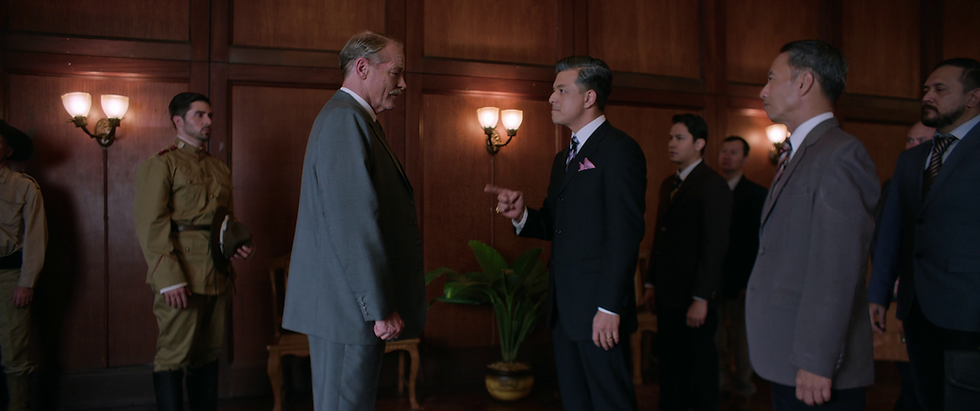
We're now in the Cabinet Crisis part. Once again, there are sources online where you can get more info on what happened, so I'm just sharing screenshots for some of the inspiration for the dialogue in this specific scene.

Wood's voiceover/letter was combined from several sources. We didn't have much difficulty keeping Wood's dialogue authentic as it was inspired by his letters and diary entries. Iain Glen would occasionally offer dialogue suggestions to keep the English idiomatic and grammatically consistent with a native English speaker. I appreciated that a lot.
My favorite bit here involves the wives of Quezon and Roxas putting a pillow over their heads so they can get back to sleep.
Most of the women in QUEZON are so over the drama of the men in their lives.
The part where Wood cuts the budget for independence missions actually happened, but it was one of several instances of Wood clamping down on spending.
Meanwhile, the revenge budget cut targeting Wood was based on this passage.

Another shoutout to the visual effects team for this shot. Was really impressed with the background work here.

The famous "government run like hell" speech. I think Echo stunned the students who played the extras here.

I remember this day very well because the set up took so long that I had to brisk walk around the gymnasium until I got my 10,000 steps in. I got to 10k and the setup still wasn't over. On the upside, we had lots of time to be silly.

This was the first day of our shoot. I usually schedule scenes that are very easy to do as buena mano for Day 1. However, this scene took us almost all morning and involved numerous takes. Maybe it was collective jitters. Maybe it was the fact that this was my first full length feature film since 2018 (not counting SRR Mukbang in 2023).

This very short scene is set in the Ortigas law firm. Quezon worked for Don Paco Ortigas in his youth. Fernando Ortigas, one of the pillars of TBA Studios who produced the Bayaniverse films, is Don Paco's grandson. There's a real photo of Don Paco (or maybe it was his son Paquito) and Quezon in the background.


If I remember correctly, this scene was Echo's first day of shooting. He gave me a vintage 20-peso bill as a gift. We were still having problems with prosthetics at this point and raced to fix everything while the sun was setting. But with these two actors, in this quiet but important scene, all I had to do was watch them perform. When it comes to actors, the director's job is mostly to cast the right people. I don't believe in having the magic words to make them perform, emote, etc. They have their own ways, and if they're pros, they come to set with the characters already alive inside them. I'm only there to define the space where they'll play in.
In this scene, Quezon mentions a speech he gave in Washington in praise of Aguinaldo. Here are excerpts:
But when Aguinaldo refused to side with Quezon over the Cabinet Crisis controversy, that's when the fight began.
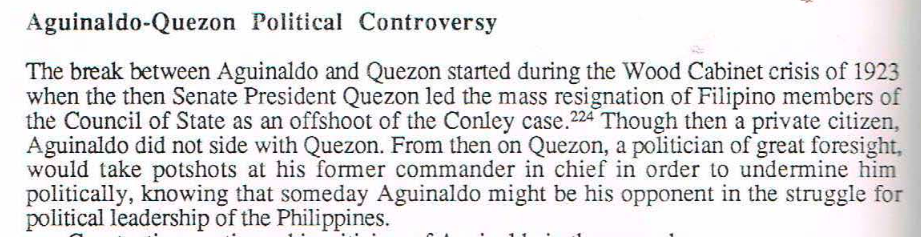
At this point, the Katipunan revolt was decades ago and Aguinaldo was considered by some people to be a relic. Aguinaldo himself knew that he'd largely been forgotten by the youth, but the eulogy delivered by then Senator Ferdinand Marcos in the 1960s summarizes the sentiment best.

In GOYO: ANG BATANG HENERAL, there's an Apolinario Mabini voice-over that criticized the revolutionaries for having the temperament of children. That was actually taken from a letter Marcelo del Pilar wrote to Mabini. Surprisingly, Leonard Wood had the same criticism.
As for Wood's car accident and Aguinaldo arriving to sit down with him, that actually happened.

Their conversation about politics, including Wood not having any fondness for the game, was based on these passages:
Aguinaldo giving his support to Leonard Wood was one of many "miscalculations" he made throughout his career. Wood benefitted from it greatly, with the fight now focused on Filipinos vs Filipinos, instead of Filipinos vs colonizers.
TJ Trinidad, the original actor we cast for Manuel Quezon, makes a super quick cameo in the film. There's behind-the-scenes footage here. And we talk about his set visit here.


Despite Quezon's public fight with Wood and the ongoing drama of the Cabinet Crisis, Quezon always had access to the back door of the Palace.


Meanwhile, Wood's joke about borrowing the Intrencherado's crown for Quezon to try on was taken directly from his diary.

Wood is described in sources as gruff but with a dry sense of humor, and imbued with a level of patience toward Filipinos that even the Americans found impressive.

You can see examples of how he was in office below.
This is the main reason why Wood was characterized that way in the film. Given Wood's checkered past, I'm aware some people would prefer if we just put devil horns on the white colonizer and call it a day, but that's not how we tell this kind of story. Some films can afford to paint things in black and white. But if you want your story to be closer to reality, you have to acknowledge that a person can swing from evil to good to utterly normal at any point in their life. Somewhat in the same ballpark as Hannah Arendt's "banality of evil" idea.
In the same manner, QUEZON attempts to add more dimensions to the institutionalized idea of Manuel L. Quezon as father figure, leader, savior. The film is saying there's more, not that what we already know is irrelevant just because we're showing something new. It's not a zero-sum game.

Quezon spent six years in Washington learning the ins and outs of statecraft. He didn't know any English at all when he arrived and impressively learned on the fly. The lack of English proficiency was a detail we ignored in the young Quezon scenes featuring Benjamin Alves, obviously. It's mostly for the sake of convenience—ours and the audience's. As long as it didn't affect the story too much, we could get away with this bit of inaccuracy.
In the early years of American rule, the Americans dug up as much info/dirt on the people they've handpicked to collaborate with.

They had PLENTY of ammunition on Quezon, but Quezon's relationship with the Americans in his younger days was one of mutual respect, with secrets kept against each other as insurance. And the Americans definitely had their own secrets to keep.
As for that astonishingly arrogant line about being so handsome he wouldn't need to rape anyone, that came from here:

This was the Tomasa Alcala case. You can search for some details of it online. Quezon admitted to having sex with her but denied the rape. Nobody knows what really happened and, to be fair, there's a good chance it was a demolition job set up by one of his American foes.

That folder drop was a little textural touch I had to add in the scene. If you have sharp eyes, you'll see the thread attached to the folder at some point. There was a guy hiding behind Iain Glen on the other side of the desk.

Another example of compressed timelines here. The film makes it look as if Wood died right after that drinking session with Quezon, but there was a good 4 years between the Cabinet crisis and Wood's death from a botched surgery.

One of my favorite Benjamin Alves scenes. Choreography provided on the spot by line producer Lexter Tarriela. The silent film sequences were shot over two days in a studio in Pasay. It was one of the most fun and relaxing parts of the entire 30-day shooting schedule.

The lanzones joke. I honestly did not know it was a thing. Joross Gamboa kept adding stuff in his scenes (something I encouraged) and I went with a lot of them. Apparently it was a naughty joke made by Joey de Leon or something. Whatever. I'll add anything as long as it makes the scene come to life.
"Mi querido" is a term Quezon and Osmeña used in their letters to each other. Apparently, it was a pretty common expression. It should be noted however that the borders of masculinity were a little different back then. Machismo was in full swing but there was also more tenderness in male-to-male relationships.

I call this whole sequence Ligaw Part 1. Quezon was indeed sick and agreed to send Osmeña and Roxas to the US, but was he actually cooking up something again? The Osmeña books had something to say about this tactical move.

I have no idea if Quezon or Osmeña ever read Arthur Conan Doyle (Holmes and Watson reference) or Miguel de Cervantes (Don Quixote and Sancho Panza reference), but I had to use them because the metaphor Quirino used in his book was even more obscure.

Good lord, the Hare-Hawes-Cutting Act vs Tydings-McDuffie Act montage. This was the hardest one to compress. I remember one post-screening Q&A when a female school teacher expressed her gratitude because she finally got the gist of the whole debacle then expressed indignation at the power games Quezon played. I thanked her but also reminded her that the whole drama was simplified. At best, historical films show you the door. It's up to you whether you want to enter and, to mix metaphors, do a deep dive.

But, yes, here he was again, playing the game.

About the music. It wasn't that difficult turning the Hallelujah Chorus into a rondalla + orchestra ensemble as there are plenty of rondalla ensembles in the Philippines that have performed the piece. It was just tedious to play on the keyboard. I used a mandolin virtual instrument that had tremolo notes, layered on top of guitars and banjos. I don't have rondalla virtual instruments. I just made do with what I had.

Too bad you can't immediately see the guy holding young Quezon's left foot in both the Jones Law and the Tydings-McDuffie silent films. I asked him to kiss Ben's shoe for both scenes. Shoutout to the good sir for being such a sport.
Ligaw Part 2. If it's not yet obvious, this is a recreation of Ligaw Part 1 shot-for-shot. The blocking, the sequence of shots, the framing, and most of the action. Sometimes you just have to be literal in a visual sense to sell the idea that shit keeps happening over and over.
Osmeña's "I have followed you..." line was taken from here:


The two strongest adlibs in the film happen in this scene. "Hindi ako kulangot..." was something Romnick came up with during the table read. "Kaninong puntod mo kinuha..." was something Romnick and Echo came up with on the set in between setups. These guys, I swear.
To be continued in Part 4.


Comments