
QUEZON: From Page to Screen (4/6)

QUEZON v AGUINALDO
You Can't Lose With Quezon!
Despite his mestizo lineage, Quezon didn't come from a rich family. That is why the support his lavandera gave him during the gubernatorial campaign—she provided meals for his supporters using her own life savings—meant so much to him.
It's a great underdog tale, but of course, by this point in his life, Quezon already had the necessary support of the Americans. His opponents proved no match for Quezon's tactical alliance with the American military. More on this later.
The original music cue in this silent film segment is one of my favorites. It's actually quite difficult to emulate orchestral scores of the silent film era, especially the good ones. Many modern film composers rely on atmosphere and textures, but old school Hollywood composers were well-versed on harmonic complexity, orchestration, and melodic layers. It's a different school of thought, a different approach. Filipino films around the 1930s to 1940s also employed composers who used sophisticated orchestration since we were trying to emulate Hollywood.

This scene is a reference to several tree-planting ceremonies Quezon held throughout his career.

Folk song "Pobreng Alindahaw" plays on the soundtrack, another rondalla-inspired cue that I had fun making. I just wish people got to hear the chorus, but I ran out of visual material to stretch things out. Why this track? The lyrics, mostly. But also I think it's my first time using a folk song as a musical cue.
The duling scene. No notes. Just pure Quezon charm.


This scene was shot in Central Azucarera de Tarlac, which still has some operational early 20th century structures. I grew up near a similar American-era sugar refinery in Canlubang, Laguna. Those were owned by the Yulos, who also figured in Quezon's life. The first version of the QUEZON script included a short scene with Jose Yulo.
The barrels in this scene contain rum. I don't drink alcohol that much, but I did ask for a bottle. I use it now to make French Apple Cake. Heh.

Quezon's supporters shouting Fuego los veteranos, amigos de Wood is both right and wrong. Right in that it did happen in Negros (the sugar capital) back in 1926. Wrong because they shouted Fuera, not Fuego. They mean different things. I remember changing it to fuego at some point during the prep stage, thinking I made a typo in the script. Then I checked Ambeth Ocampo's book after the film's release, and voila, it's fuera. Sigh. We do our best, but sometimes, the littlest things just slip past you. Second guessing is especially pernicious.

At least we got the gunpowder insult right.


After Quezon denied his affiliation with the Veteranos, Aguinaldo brought out the receipts.

I'm not fond of oners (scenes shot in one unbroken take) that rely on logistics and blocking since most of them call attention to themselves. However, I do like oners that are purely based on acting skill. So I let Mon Confiado be Mon Confiado and gave him a visually simple oner. His speech is based on the following.

Originally, I wanted to shoot this speech inside the Kawit shrine in Cavite as the interiors were truly impressive. I also wanted to pay homage to their struggle. But somehow we weren't allowed even though it seemed we were about to be greenlit. I wonder why?
The campaign montages were built on contrasts. Quezon-Osmeña parades were lively, loud and colorful. Aguinaldo-Melliza parades were dull, quiet and featured mostly senior citizens. This is an exaggeration, to say the least. But we needed to drive home the point that Quezon was hugely popular.

Aguinaldo's speech was based on this.

Quezon, meanwhile, had the pulse of the younger generation and the general public. The Americans already sensed this early in Quezon's career.

Melliza stumbling on the steps is based on this passage.

We've already covered Quezon's womanizing in Part 2, so we're skipping Aguinaldo's warning. If you get a chance to read the Quirino book (out of print, only available in libraries), you'll find more passages about his love affairs there.
About the fireworks...
Sometime after GOYO's release in 2018, and before I nuked my Twitter account, some history enthusiasts on Twitter shared an old newspaper article announcing a fireworks show by Eduardo Rusca. I mean how many Eduardo Ruscas are there in the Philippines? I checked one of those genealogy sites and found only one entry. So I figured Old Rusca probably did end up running a fireworks business. So here we are.

Another favorite transition, especially with the audio from the movie Aurora's watching adding an extra layer of meaning.
Co-writer Rody Vera originally put in CAPTAIN BLOOD (1935) in the script for the movie, but since we've been recreating public domain music already, I figured we could try finding a public domain film for this scene.

Lo and behold, DW Griffith's ABRAHAM LINCOLN (1930). A perfect fit. Didn't matter that the film was already 5 years old when they were watching it in Cine Hernando. It had the right subtext for Quezon and Aurora, and it also provided the perfect inspiration to Quezon for the silent films.
Quezon recruits Nadia Hernando with complete faith in her abilities. Joven reveals that she's a fan of Fritz Lang and Murnau even though talkies were already a thing by 1935. This turns the scene into a kind of Mobius strip configuration.
Quezon talks about the production studio Filippine Films, owned by Harris and Tait
Nadia shows Quezon her work-in-progress film
We fashioned Nadia's work-in-progress film after ZAMBOANGA (1937), a film produced by Filippine Films
ZAMBOANGA is kind of an answer to TABU (1931), a film by F.W. Murnau
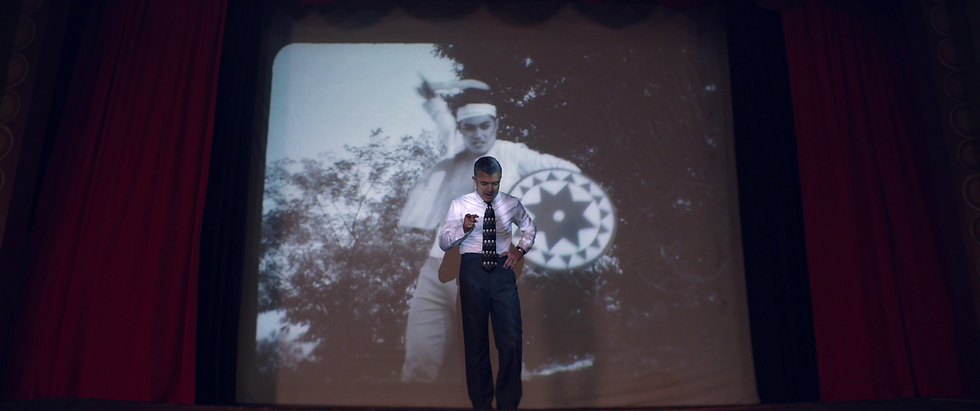
There are several instances in this shot where Ben Alves looks like he's about to strike Echo. Makes me giggle every time. A coincidence, for the record. This is one of our more explicit CITIZEN KANE (1941) moments. I rewatched that film maybe 3 to 4 times during prep stage. It's the kind of film that bores you when you're young but keeps getting better and better as you age. I'm not going to enumerate all the films and shows we studied, but if it's a political satire of some sort, there's a decent chance we saw it. And for the record, despite a few kids saying QUEZON is very Wes Anderson, I barely watched his films during prep. I understand if that's the younger generation's point of reference. I will however give a shoutout to Preston Sturges' THE GREAT McGINTY (1940) and Mike de Leon's BAYANING THIRD WORLD (2000).

I think Echo was genuinely surprised when Therese did this gesture. When you're a filmmaker, one of your top concerns for a new project is the budget, so I told her to just hold her palms up.

Charles Valentin Alkan's "Etude sans opus" drives this extended montage of silent films. It's one of those rare times I'm glad the algorithm gods showed me something I haven't heard of but totally enjoyed. The energetic piano piece apparently reminds modern audiences of 8-bit video game music. Fair enough.
As a lawyer, Quezon had a policy of not charging poor clients while charging a hefty fee from rich ones. He quickly became popular, winning so many cases in favor of the underclass. The first version of the QUEZON script actually dramatized the Francis Berry case. When Amazon came on board and requested a rewrite, the Berry case transformed into a silent film.
Amazon ended up not producing QUEZON, but we used the Amazon version for the film and Amazon did acquire and release QUEZON on Prime Video PH.
This scene parallels my own dilemma in choosing which parts of Quezon's life to dramatize. We already had the opportunity to tell any story we wanted to tell about a complicated man, so the least interesting path was to play it safe. The Bayaniverse films have always been about turning saintly monuments into fallible people.
As for the first version of the script I keep referring to, I can't show that here. But here are a few threads that were already written then dropped in the second version:
Quezon letting down socialists Pedro Abad Santos and Luis Taruc. I was already planting Taruc so he would carry over to a possible Magsaysay film, along with Aurora Quezon. I bet you know where this part is headed.
Quezon vs Benigno Ramos and the Sakdalistas.
Jose Yulo and then Supreme Court Justice Jose Laurel. Quezon actually dances the tango with Laurel in this version, not with Osmeña,
Rusca with a girlfriend named Lira and a dog named...Paco. If you know, you know.
Instead of Nadia's films framing the story, the entire film happens over a game of poker between old Quezon and old Joven in Baguio a few days before the Japanese invasion. Aurora Quezon, in the meantime, watches Nadia's films inside a private theater, but we barely see the films.
I also had a completed script for a short film bridging GOYO and QUEZON, a la ANGELITO. It was a simple conversation over coffee where Nadia meets her future lawyer boyfriend. Tiyo Miguel was playing matchmaker. Nadia and the guy were discussing another one of Quezon's dramatic court cases.
My point in sharing this is that film is a medium of omission. So many factors come into play when polishing a story. In historical films, we have to narrow down the point of view and keep trimming until we have the leanest story we can come up with. What we choose to omit is often a result of creative decisions.
For the record, I'm glad that we got a chance to rewrite the script. I thought the first version was a little stiff and convoluted, even though co-writer Rody Vera thought it was wilder.

Here's the basis for Aguinaldo's attack.


Quezon's defense and the phrase "moral assassination" were based on this:
To be fair, Quezon did make some smart moves with his finances.
This was the part in the Quirino book that convinced me there was a film to be made about Quezon that focused on power plays and Machiavellian tactics.
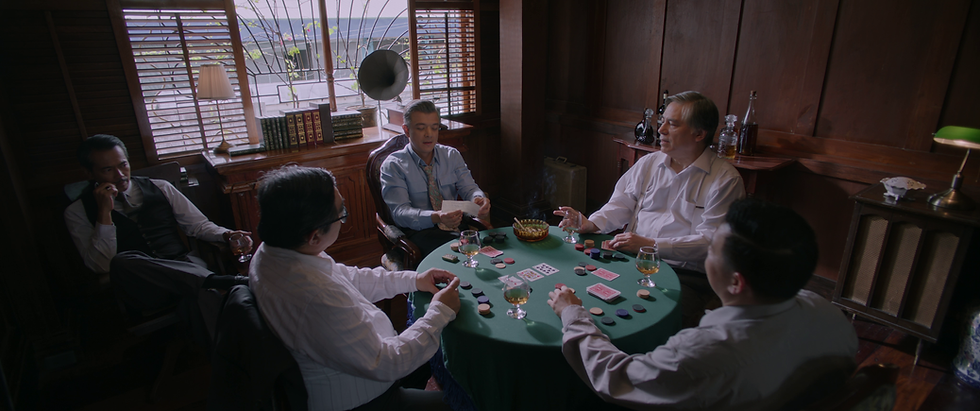

It was one of those "wow this shit is real?" moments during the research stage. To be clear, it's not that a politician asking for money is such a shocking thing, it's that a biography on a Filipino president openly admits this. Maybe Quirino meant this to be funny in an endearing way, like "bros will be bros, you know?" That's valid. But we found it funny in a tragicomic way.
Quezon in our film understood the numbers game embedded in the democratic system. To be popular, one must control public perception. This goes beyond dapper suits and charm; it's an ecosystem of support from the powerful. More on this later.

Bayani, makamasa, may malasakit. Once again, the Big Man phenomenon plays a huge role. But some people saw this differently.

Here's probably the biggest creative license we took outside of the invention of the Hernandos. The man who made the statement to the press regarding Aguinaldo's involvement in Luna's death was Pantaleon Garcia, not Pedro Janolino, as we did in the film.

Why make this change? First, Garcia serves the same function as Janolino in a narrative sense. They were both close to Aguinaldo and served under him during the revolution. Rather than introduce a new character in the Bayaniverse, why not just bring up an old one who we actually saw in the Luna assassination? If we used Garcia, we would have to create a new narrative thread to tie him to HENERAL LUNA since he has zero recall. If we used Janolino, we would tick off all the checkboxes immediately. Plus, Ketchup is always fun to work with. Include that in the checkbox.

And so begins the word war between Quezon and Aguinaldo. Once again, a reminder that these are compressed timelines, made to look in the film as if everything was happening during the campaign.

Aguinaldo repeats what he said in the closing scenes of HENERAL LUNA in reaction to the news reports. Then Quezon brings up Mabini's harsh criticism of Aguinaldo from La Revolucion Filipina, which featured prominently in GOYO.

In the Quezon-Aguinaldo scene at the end of GOYO, Aguinaldo keeps his thoughts to himself regarding Mabini's criticism. The old general loved Mabini, so it must've hurt to hear Mabini blame Aguinaldo for the revolution's failure.
Melliza counters Quezon's attack by saying Mabini shouldn't be believed. This is one of the very few parts in the film that I shortened because in the script, Melliza mentions that Mabini was influenced by Gen. Artemio Ricarte during their exile in Guam. Ricarte and Aguinaldo were not on good terms.
Of course, I cut it out because we would be introducing another character that had no established threads in the previous two films.
Quezon then downplays Aguinaldo's accomplishments and praises Bonifacio's heroism instead. In the film, we show the bricklaying ceremony of the Bonifacio monument in Caloocan.

I wish we had enough space in the film to dramatize the drama behind Bonifacio's bones. I wanted to intercut that with a scene where Osmeña went to Ilocos Sur to help authenticate Goyo's remains from his gold tooth. A real event, by the way.

I have no reason to put an Iza Calzado cameo in this film other than she's been a really kind and warm friend to me and we haven't seen each other in a while. Plus points for her husband Ben Wintle's cameo. I'll never forget Ben fumbling over an airplane door that he accidentally opened and couldn't close again in our shooting location (they had a full airplane on display). Real life slapstick.
Joven and Rusca dare each other to post Quezon's campaign posters in Kawit, Aguinaldo's territory.
In case you're wondering what happened in between, that's the mid-credits teaser that appeared in GOYO, which is on Prime Video PH now along with QUEZON and HENERAL LUNA. However, we shot an alternate version of that mid-credits teaser that's evidence of my occasionally juvenile brain.
Anyway...the interaction between Joven and the farmer is a shortcut that brings to light some of the criticisms against Quezon's social justice programs.

The young lawyer who valiantly fought for the poor and the oppressed is now on the other side, defending himself against accusations of greed and siding with the elites.
Here's the summary of the Paliparan tale from Ambeth Ocampo's book.
I tried to imagine what kind of wife and daughter Joven would have and I came up with Carmen and Nadia, two people Joven would be having interesting conversations with over hot chocolate and merienda. Ana Abad Santos mentioned at some point that she saw Carmen as sort of a ghost editor of Joven's writings. Exactly.
This entire scene took more than 10 takes total, if we count every camera setup or every angle. For some reason, Joross decided to eat a banana for every single take. When we wrapped that night, he went home with no appetite for dinner and a stomach ache.
Also, Nadia, whose name means hope, quoting the most world-weary line ("The world will change you first before you can change it.") from a tired Uncle Miguel is just something I found personally funny.
To be continued in Part 5.


Comments