
QUEZON: From Page to Screen (5/6)

Updated: Jun 3
QUEZON v AGUINALDO
You Can't Lose With Quezon!
The Bataan Miting de Avance. A fictional meeting of the three camps, but with speeches and events derived from the books. The entire scene, from start to finish, took two days to shoot, with around 50 shots to cover all necessary angles, reactions, and spatial relationships. To be honest, I could've used a few more shots to really sell the drama but we couldn't afford to add more. Also, we could've used maybe a hundred more extras, but aside from budget constraints, I was worried about the venue. This scene was on the second floor of a Spanish-era building. I wasn't sure it could hold everyone's weight safely.
Anyway...the microphone feedback blunder. Yes, it's a trope, but I couldn't resist.

We had a last minute second-guessing panic attack regarding Aglipay's clothes. Should he have worn vestments? But there are pictures of the bishop wearing a suit, so we figured we're safe. And it's a national campaign, so it would've been theoretically more appropriate to wear non-liturgical clothes.

Anyway, Rody Vera dug up Aglipay's own words to be used in the scene.

Meanwhile, Quezon saying "Politika lamang, walang personalan" was based on this.
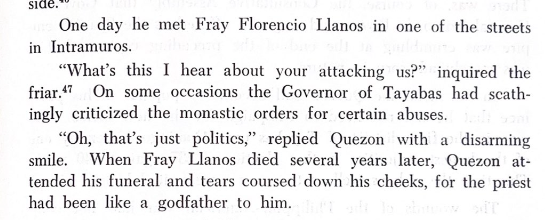
Then Quezon goes full attack mode on Aguinaldo, shaming him while implying his lust for power.

This sideways punch gesture was something Echo and I discussed during the shoot. It was based on a popular photo of Quezon delivering his speech at the presidential inauguration. We figured it would be good to make this a signature power move.

Speaking of signature moves, the hat tip by the lawyer was also meant as a quick visual recall to the farm closure.
The repealing of Aguinaldo's pension happened in 1938, a few years after the election. Quezon and Aguinaldo patched things up in 1941, as per Javar's book. While there's no mention of the pension being part of Quezon's political games, Quezon was still going after people attached to Aguinaldo even after he won. So this was another bit of creative license on our part.
Sometimes, I attach a temporary score during editing. For the slow motion shot, I used a segment from SUCCESSION, which is a great TV series about power games and Machiavellian tactics. I think you can hear its influence in my actual score for this scene.
Aguinaldo's speech was inspired by the Calairo book "Saloobin" where Aguinaldo defends himself point by point against every accusation regarding the revolution. It's a book I'd been wanting to use since HENERAL LUNA because I wanted Aguinaldo to have a chance to defend, if not redeem, himself. The plan from the start was always to give Joven and Aguinaldo arcs that are in line with the Bayaniverse deconstructions: Joven, the observer and audience surrogate, becomes complicit and morally grey. Aguinaldo, the first film's villain, becomes more nuanced and sympathetic with every film.
As for the pork barrel part of Aguinaldo's speech...
I enjoyed staging the bit below. Doña Aurora looks behind her and sees Quezon flirting with a lady. Aurora turns away, only to come face-to-face with Quezon's past—his first wife, Ana Ricardo.
I rarely get to do color transitions, so I'm glad I finally had a solid reason to: from "real life" to silent films. The story world becomes one with the real world.
Now let's talk about Ana Ricardo. First of all, rest in peace, Sue Prado. Despite her immense talent, I was only able to cast her twice in small roles. I don't know if QUEZON was her last film appearance, but I'll always regret not having worked with her enough. Such a huge and shocking loss for the industry.
Despite some claims that Ana Ricardo was just a rumor, there's actually plenty of stuff about her in the Quirino and Javar books. There's also an interesting reason why she hasn't been discussed enough. See the screenshots below.
Now about Aguinaldo deciding not to invite Ana Ricardo onstage. In the film, you could interpret this as either Aguinaldo having delicadeza or just not having the balls to play dirty. But there's more stuff to be mined from this if we include the actual sources.

In the books, Aguinaldo did invite Ana Ricardo onstage, but not in front of Quezon. And he certainly didn't reveal that she was his first wife. In the screenshot, you'll notice the part of his speech we used in the film.
Here's a question I kept asking: is it possible that Aguinaldo's outrage wasn't rooted in Quezon's bigamy as much as in his abandonment of Ana?
Aguinaldo himself had a relationship with another woman before Maria Agoncillo. Her name was Amparo Arac. Aguinaldo had three illegitimate children with her. The difference between Quezon and Aguinaldo was that Aguinaldo's immediate family took care of Amparo's children even after the general married Agoncillo. Amparo married someone else and lived her life well, as far as I know.
There is an important detail about Amparo that I haven't included as it isn't central to the trilogy's themes. It opens up an entirely different conversation that is outside of the film's scope. The Saulo book discusses this period in more detail.

Honestly, my favorite character amongst the fictional ones is always Miguel Laureano, who was named after Felix Laureano, the first Filipino photographer. World-weary, pragmatic, skeptical (not cynical). He understands more than he lets on. He's been with the Bayaniverse since ANGELITO.
For a scene that required around 300 extras, the Quezon parade wasn't super hard to execute. My main concern was really the amount of modern elements we would ask the VFX team to erase or change.
That medium shot above showing Quezon waving at the crowd—the background is CG. Lovely work once again by the VFX team. But overall it was tough work personally identifying every CCTV, air conditioner, modern lamp and clusters of spaghetti wires in scenes filled with so many moving parts. We actually have one shot in the film that still has unaltered mistakes, but I'm definitely not going to say where it is because once you spot it, you can never unsee it.
Once again, contrasts. Quezon's parade is bright, loud, colorful. Aguinaldo's parade has way fewer people and is expressed in muted tones. As opposed to the Quezon parade, this was the hardest scene to shoot in the entire film. Considering that it has way fewer extras, Aguinaldo's parade still required the most care in selecting shots and making use of the shooting location. Mood and pacing were super important.
Even though the parade was extensively planned, many things went against us that day, including the lack of extras, delays, the summer heat, the noise. But that's where planning works best—when nothing goes according to plan. Because once you have the schematics in front of you, all you need to do is figure out which parts are still under your control and which aren't. For things out of your control, you improvise. The rest, you stop thinking and stick to the plan.
By the day's end, I was close to tears from exhaustion. But we made it work.
I was supposed to start changing the mood of the intercuts when the Bulacan folk closed their windows at Aguinaldo, but Karylle made a distinct facial expression that allowed me to shift to an ominous mood one scene earlier.
The backgrounds behind and in front of Aguinaldo are all CG. Shoutout to the extra effort by the VFX team in recreating the Barasoain church behind the black-veiled lady. It's where all of this happened. Source later.
The funeral parade was shot in Taal, Batangas. The street was a little narrow and was flanked by Spanish-era houses on one side and a nondescript wall on the other. Perfect for the scene. We still had problems with CCTVs, lamps and wires but we just did our best removing them in post while keeping some that weren't too obvious or could pass off as something period-plausible.
I wished the street was just a few more meters longer, but since we couldn't let our actors march farther, I decided to use slow motion to prolong the scene. That had the extra benefit of adding to the tension.
Shoutout to our sound folks Imman and Nerikka over at Filmpost for the extra effort in harmonizing the note of the church bell to the chords of the score. It's a little thing that no one will notice, but that's what makes post-production jobs fun.
Two things worth mentioning here: 1) Rusca lights up a row of kwitis. As far as I know, you can't choreograph kwitis and have them all go off at the same time. I'm just glad it only took a few takes for the kwitis to go off the way they did in the film. Resetting a parade is a pain in the ass.
2) The CongTV cameo. The marketing team asked me to put him in the film. All I knew about the guy was that he has a large YouTube following and that his politics is frowned upon by a certain demographic. So I put him in the most appropriate place I could think of and he did a very good job with his few lines. I have zero complaints. Cast and crew don't need to agree with one another politically for us to work together.
Alright, time for the source. The Barasoain funeral march happened a few years before the election but was still well within the years-long feud between Aguinaldo and Quezon. Saulo provides only a short account, but it was enough to build a scene with.
Special thanks to Mr. Isagani Giron, who helped us during the making of GOYO, for providing anecdotal evidence regarding Aguinaldo's dialogue at the end of the parade. I forgot if he was actually there in the parade as a young kid or if he knew someone who was there, but the line stuck with me.
As for the reveal that Janolino was Quezon's sergeant-at-arms, we already explained the switch from Pantaleon Garcia (Quezon's actual sergeant-at-arms), but here's additional info.
So now, Joven finds himself in the same position Ana Ricardo was in: face to face with the smoky brick wall that is Manuel Nieto. As a result, Joven writes the opinion piece that will destroy his career.
The spoils system, patronage politics. You can easily find definitions for these terms online. And while you're at it, look into bureaucrat capitalism as well for a related framework. The Paredes book offers a summary of Quezon's reach throughout the political landscape, all achieved with skillful persuasion and leverage.
Meanwhile, Quirino has more explicit examples of how Quezon secures money and dispenses favors. I'm including pages from the Paredes book as well.
I'm including here Manuel Roxas' criticism of Quezon, which I previously said I'd include in Part 3. While this statement was made during the HHC and Tydings-McDuffie debacle, it's a sharp summary of how Quezon was seen by many of the most important figures around him.
Quezon's inauguration was held in what is now the National Museum. After it was bombed in World War 2 and rebuilt, the building underwent some structural and cosmetic changes. Thankfully, there are still parts of the facade that can be used to recreate the event. And thankfully, the National Museum agreed to let us shoot there. The number of people in the actual 1935 inauguration was in the six figures. We only had around twenty. The solution? Shoot low angle, hide the emptiness but make the scene feel big with acting and a grand score. Cinema, I suppose.
Echo's speech here was lifted from the actual inauguration speech. No need to post screenshots. I think you can find it online. You can see him doing the power move again, this one more based on the classic photo.
The National Museum sits right along a busy urban thoroughfare packed with loud vehicular traffic. By default, we gave up on the idea of recording clean audio and settled for ADR (dubbing), but somehow we found a solution on the spot. There was a stop light across the road that gave us around 30 seconds to do the speech with all vehicles standing still. Echo timed everything so that when the light turns green, he's done with the speech. Audio problem solved!
I have nothing more to add to the Quezon-Osmeña dance scene other than we have a 30 second version of their choreography. Maybe someday TBA will release that along with the Quezon-Aurora dance.
The circling steadicam shot featuring Quezon's businessmen friends made the operator dizzy. I seem to have a talent for depleting the energy of our steadicam operator because the same thing happened in that long flashback oner in HENERAL LUNA. Thankfully, we got through it and I'm very happy with the results. Forever grateful to JR, our steadicam operator, for always powering through.
The list of businessmen came from this segment...

Business and politics are intertwined in this system. Is it still a democracy? Is it really the will of the people?

As Joven says in the film, Quezon didn't start this game. He played the cards he was dealt while the colonial powers defined what moves could be made within the game. Our local officials played to get ahead and appease the Americans, then we played the game amongst ourselves.
About the "Body and Soul" part.
Maj. Harry Bandholtz and Col. James Harbord were significant figures early in Quezon's career. Quezon and Osmeña were among the two promising politicians from the provinces that Bandholtz and Harbord eyed for collaboration, basically picking out the young and "progressive" as opposed to the old ilustrados.

In Part 4, I mentioned how Quezon already had the support of the American military despite his underdog status when compared to his opponents in the gubernatorial race.
The Quirino book provides details on how Quezon pledged allegiance to America in exchange for support. The gubernatorial elections required consejales to cast their votes. Utilizing the U.S. Army transport system, Quezon brought in enough consejales to Lucena to win the race.
Quezon is now in the same place Aguinaldo was when he was held in Malacañan—their allegiances pledged to the colonizer, except Aguinaldo did so in defeat. Quezon did it to win. By this point, the revolution was already lost and the only way to survive was to exist within the new system.
Did Quezon really say the words body and soul?

One of the more satisfying things about making QUEZON was finding ways to tie the whole trilogy together. This hilltop scene is, of course, a throwback to HENERAL LUNA. Luna held his lucky coin, Joven holds the coin Quezon gave to him.
We returned to the very same hill, scrambled to the top as it was very late in the afternoon, and was fortunate enough to catch the same kind of sunset to recreate the shot from LUNA.
Young Joven reflects on his experiences with Antonio Luna and Gregorio Del Pilar, but it's the old Joven, after realizing his indebtedness to Quezon, who closes the thread with a question. Because it's really all the film can offer. Questions, not answers.
The closure of Alerta was inspired by real events in Quezon's career. The study guide by Alvin Campomanes has more details about this.


We started the film with a fictional argument about how Joven and Quezon are different from each other. Now we have an argument that shows they're the same.
I suppose this is the biggest "twist" of the trilogy, that the person who originally represented the youth can't help but be part of the system in order to survive. That, in mistaking rhetoric for structural change, he built a trap for himself. You keep attaching yourself to these figures and soon you're part of their circle. Joven's closing questions in his opinion piece should've been directed at himself more than his readers. Of course, he denies it when Quezon points out Joven's part in the game, but Quezon wins the exchange, naturally. Journalism, media, and art are inside this circle by way of capital and proximity. The ones that exist outside, do they last long enough to have an impact?

In the end, Quezon returns the coin to Joven. Echo throws it off frame, over the camera...except the second camera is set up behind the first one, facing the opposite direction, filming Joven, Nadia and Rusca.
I mean that was bound to happen. Sorry, Nadia.

Quezon got his second term and some emergency powers to boot. We'll skip the editorializing and just share a political cartoon.

The speech is again based on the actual inaugural speech for Quezon's second term. We tried to put in as much detail as we could for the second inauguration though I suppose the girl with the hand organ was the most unique.

For a film that's about power games and winning, I thought the most poignant way to end the film was to show Quezon still wanting to win despite his fragile health. I suppose the second term was a pyrrhic victory, at best. To see the country finally achieve independence would've been his crowning achievement, but he didn't win that one, obviously.
Did Manuel Quezon say those words at the tunnel? He said them, but in a different location and at a different time. I just thought there was no other way to end the film but to use those words.

We started the whole journey with Quezon moving towards the light and ended with Quezon being dragged into the darkness.
For the record, that tunnel is the Centennial Tunnel in Aringay, La Union. I found it in Google Maps myself. We actually went to Malinta tunnel in Corregidor to check the feasibility of shooting there, but once more, budget constraints forced us to rethink our ambitions. Fortunately, the Centennial Tunnel worked for our story.
Conclusions/Final Thoughts in Part 6.


Comments