
QUEZON: From Page to Screen (1/6)

Updated: Jun 2
Since there is unlikely to be any physical media for QUEZON, I won't have a chance to do a director's commentary for the film. So let me do it via a series of blog posts instead. This is for all the nerds out there.
I've mentioned in many places that we went through roughly 50 titles during the research phase. Some books were significant from cover to cover, others had chapters or passages relevant to the project, regardless of their period in focus. To help me make sense of the massively tangled web between Quezon, Osmeña, Wood, Aguinaldo, etc, I made a mind map that connected the threads. Then I constantly referred to it during the writing phase. Here's what it looks like:
The film's main source was Carlos Quirino's "Quezon: Paladin of Philippine Freedom."
The actual list of titles is here, in rough order of significance (click to expand).
Quezon: Paladin Of Philippine Freedom - C. Quirino (1972)
Dinamismong Pampulitika - R. Javar (2021)
Bones of Contention - A. Ocampo (2001)
The Good Fight - M. L. Quezon
Policing America's Empire - A. McCoy (2009)
Leonard Wood: A Biography - H. Hagedorn (1931)
Leonard Wood and the Philippine Cabinet Crisis... - M. Onorato (1967)
Colonial Crucible - A. McCoy (2010)
Pres. Sergio Osmeña: A Fully-Documented Biography Vol 1 - V. Pacis (1971)
Pres. Sergio Osmeña: A Fully-Documented... Vol 2 - V. Pacis (1971)
The Life and Times of Don Sergio Osmeña - G. Llanto (Thesis, 1954)
The Truth About Aguinaldo and Other Heroes - A. Saulo (1987)
Emilio Aguinaldo: Generalissimo and President... - A. Saulo (1983)
Saloobin: Sagot ni Hen. Emilio Aguinaldo Sa Mga Paratang... - E. Calairo (1972)
Roxas - M. Lichauco (1952)
Philippine Colonial Democracy - R. Paredes (1989)
Cine: Spanish Influences on Early Cinema... - N. Deocampo (2007)
Film: American Influences on Philippine Cinema - N. Deocampo (2011)
Native Resistance: Philippine Cinema and Colonialism - C. del Mundo (1998)
Philippine Electoral Almanac Revised and Expanded (2015)
Governor General Wood and The Filipino Cause - M. Quezon, C. Osias (1924)
Manuel L. Quezon: The Tutelary Democrat - A. Gopinath (1987)
Sakdalistas' Struggle for Philippine Independence... - M. Terami-Wada (2014)
Abuses in the Philippine Government During... - C. Quirino (1961)
At the Helm of the Nation: Inaugural Addresses... (1973)
Compadre Colonialism - N. Owen (1971)
Between Two Empires - T. Friend (1964)
In Our Image: America’s Empire in the Philippines - S. Karnow (1988)
Reappraising an Empire - P. Stanley (1984)
Face of Empire - F. Golay (1997)
Philippine Cartoons: Political Caricature... - A. McCoy, A. Roces (1985)
Philippine Government Under the Jones Law Vol 2 - M. Kalaw (1927)
Commonwealth of the Philippines - G. Malcolm (1936)
The Philippine Commonwealth - G. Zaide (1938)
Blue Book of the Inauguration of the Commonwealth of the Philippines (1935)
Compilation of Documents Relating to the Inauguration... (1936)
The Quezon-Wood Controversy - R. Gripaldo (Paper, 1994)
President Quezon His Biographical Sketch - E. Rodriguez (1940)
Quezon: Man Of Destiny - Carlos Quirino (1935)
Eagle of the Philippines - E. Goettel (1970)
The Man Who Would Be President - R. Mojares (1986)
Conspiracy for Empire - L. Francisco, J. Fast (1985)
Benevolent Assimilation - S. Miller (1982)
Corruption and the Destiny of Asia - S. Alatas (1999)
Elections for Sale - F. Schaffer (2007)
The New Philippine Ideology - S. Osmeña (1945)
A Nation Of Zombies - Manuel Valdehuesa Jr
The Rise and Fall of Western Colonialism - S. Easton (1964)
Pork and Other Perks - S. Coronel (1998)
American Imperialism and the Philippine Insurrection - H. Graff (1969)
Dr Jose P Laurel: War Memoirs vol. 1 - J. Laurel (1962)
The Saga of Jose P. Laurel - T. del Castillo, J. del Castillo (1949)
Terminal Four - P. Yasay (2009)
Insight and Foresight - R Constantino (1977)
Was Aguinaldo Right To Have Caused Bonifacio's Death - J. Santos (1933)
Elections & Politics Philippine Style A Case in Lipa - M. Kimura (1997)
I think my co-writer Rody Vera had other titles I wasn't able to check out. In any case, huge thanks to John Silva and The Ortigas Foundation LIbrary for giving us access to the majority of these titles.
Not every book is about the main characters. Some titles helped in understanding the lives and minds of Filipinos and Americans from the early 20th century. Others helped in immersion, in having a workable understanding of the system that came out of the failed revolution and the notion of independence that changed shape, depending on who was wielding it. Other titles helped in getting a sense of institutional legacy.
The deep dive was both a blessing and a curse. There was so much mindblowing stuff about these historical figures that it was an embarrassment of riches, but sometimes the things we found were so surprising, I knew some people would find them hard to believe or even offensive. I am not an academic, but I do love to read. And what I wanted as a director was to convey that experience of surprise and discovery when I was reading the books.
The disclaimers at the start of every Bayaniverse film, while potentially undermining the research and potency of the narrative, were a necessary gesture. They were meant to remind Filipino audiences that these films are inherently fables because, while the actual historical figures made choices we live through today, we can always engage history in different ways, not just literally or through a moralistic lens, but metaphorically—as a way of thinking about the present. With enough time and distance, the past always becomes malleable (and, yes, that's a double-edged sword).
Heneral Luna Disclaimer-1 Heneral Luna Disclaimer-2 Goyo Disclaimer Quezon Disclaimer
That's why we've always included study guides for the three films and encouraged people to read beyond them. We are storytellers, not historians. We are not bound by academic standards, even if our work is often judged through them (an occasional point of frustration, I might add). Our objective is to make you feel things about what you see on screen. If they make you think, that's even better. If they make you go out there to learn more, to figure out for yourself if you agree or disagree with the film's thesis, then we've done more than we could ever hope for.
Final note: I'm sharing screenshots of the pages that inspired the scenes in the film, but I've decided not to label which book they came from. When I was building my mindmap, I prioritized speed so as not to overwhelm myself with data. That meant when I found a usable historical text, I sometimes didn't bother connecting it to the title. It worked for me back then, but retracing them now would be tedious. To be fair, I didn't think I'd come back years later to do this blog series. Suffice it to say that the screenshots are mostly from the first 16 titles in the list I posted above. Still, take everything with a grain of salt.
Let's get right to it.
I. QUEZON v JOVEN
The Noble Lie
First of all, I'm happy to be able to complete the planned entrances.


A trivial detail in the Quirino book, but I figured the coin would be a nice little device to use in the story.

The coin changes meaning as it changes hands. Prinsipyo. Negosyo. A little nod to Heneral Luna's "Negosyo o Kalayaan, Bayan o Sarili? Pumili ka!" line. Turns out "Kalayaan" is the negosyo.
Benjamin Alves's scene with Mon Confiado in GOYO: ANG BATANG HENERAL happens right after Young Quezon's surrender to the Americans and before his incarceration.

After his visit to Malacañan, Quezon spent a few months under American supervision until he was suddenly thrown in jail.

According to sources, Quezon suffered a nervous breakdown during this time.


I remember writing a version of this scene that was more satirical. As per the Quirino book, one of Quezon's friar friends saw him in the window of the jail cell and promptly worked for Quezon's release. So Quezon's moment of clarity, his dramatic epiphany, ends up with him being saved by his connections. But I let go of that joke and went with the symbolic imagery of Spain to the left, America to the right, and Quezon "I Am The Philippines" in the middle, now ready to fight for independence.
The propaganda films Quezon commissioned from Nadia Hernando are how a hero would like to be remembered, or how we remember them by way of our institutions. This is Nadia's version 1: hagiography.
Inspired by Nick Joaquin's "A Question of Heroes," the trilogy's philosophical target was always the idea of blind hero worship. As I stated many times in public, our aim is not to condemn long-dead people, but to bring them down to our level as human beings. Once we recognize them in us, we know our limits, aspirations and potential.
Meanwhile, the trilogy's stylistic/aesthetic target was always Philippine cinema's legacy of hagiographic films. You could say that the Bayaniverse films are half about history and half about historical films as a genre. Nadia's version 2—deconstruction—tackles that duality while being nested inside a deconstruction film. Each film of the trilogy is a conversation with the Filipino audience, more than a straightforward biographical film.

Historian Alvin Campomanes grilled me on where I got the idea of Quezon using silent films in the election campaign. At the time of the Quezon study guide's release, I couldn't find the book that mentioned the use of films. There was no source saying Quezon commissioned filmmakers to make hagiographic narrative films, but Quezon and Osmeña's speeches were screened in moviehouses. Months after the film's release, I finally found the detail in Roderick Javar's book.

The decision to turn this detail into commissioned narrative films was a creative choice. It was a plausible invention that gave me an excuse to recreate old silent films, something I've been itching to do for years.
There's no need to go into great detail about Echo's casting. It's been discussed many times on the internet. And the praise he's gotten for his portrayal is well-earned. When TJ Trinidad backed out of the project, Echo just automatically came to mind. Maybe because he auditioned for the role of Antonio Luna a decade ago and my subconscious always had Echo's audition biding its time.
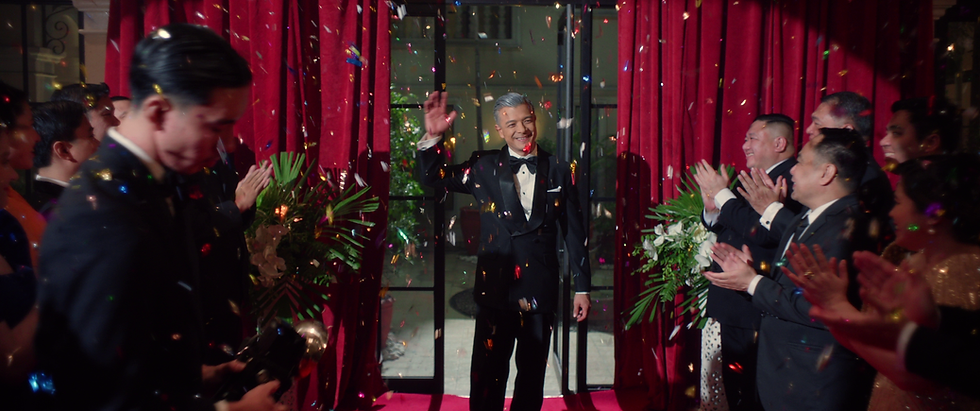
All of the character work, including the accent, was pretty much Echo's own effort. I gave the actors specific notes. We had rehearsals for certain scenes, plus a few hours of trying to sync Ben Alves and Echo's energy. But I basically let the actors find their own way into the characters. As with HENERAL LUNA and GOYO: ANG BATANG HENERAL, I was blessed with a very capable ensemble.

Quezon loved Argentine tango and was probably one of the best dancers in Manila during his time. I'm tempted to post Echo and Karylle's full dance scene just for kicks. Maybe someday I will.
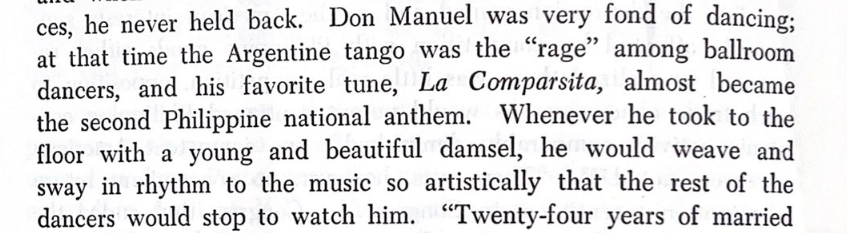

One of the funnier trends throughout the research was the numerous times Quezon threatened to resign or promised to hand over power, only to end up staying in place or landing one step higher from where he started.
The call to assassinate Manuel Quezon by Aguinaldo's supporters was a much longer drama that I had to shorten to one balcony speech. It was one of the more surprising things I encountered during research.

I wonder how much people really understood democratic ideals before the whole system was forced on us? Or do we call this Western liberal democracy with Pinoy characteristics? I don't know. Someone out there understands this better than I do.
Part of Miong's speech was also taken directly from historical sources. We do this frequently throughout the film. Sometimes, the most absurd lines are lifted directly from the books. Life is stranger than fiction.
Ana Ricardo first appears here. More on her in later parts.

Bullet Dumas has a cameo as Cabesang Doro, the ferryman who gave Quezon rides when he needed to get out of the jungle and go back to the city.


His song "Jak en Poy" appears in the trailer and the end credits. We re-recorded the song with a new band arrangement. I would've asked to play the drum tracks for it like I did in the theme songs for HENERAL LUNA and GOYO, but the post-production timeline was just too tight. I already had "Jak en Poy" in mind for the film years ago. Sometimes I have a song that I play over and over to take me through the entire creative process and set the tone. "Jak en Poy" served that purpose for QUEZON.
I had originally planned to introduce Joven Hernando's father in QUEZON. He would've been Eugenio Hernando, the non-fictional Spanish doctor who joined the revolutionary forces and was an aide-de-camp of Antonio Luna. Rusca was going to take Joven home to his father to recuperate.

Unfortunately, Eugenio's role would've been too small and would've ended up prolonging the Joven arc when the story needed to focus on MLQ. Much of the father's purpose was ultimately passed on to the fictional uncle, Miguel Laureano. I suppose I'll make any excuse to keep Jojit Lorenzo (Laureano) on screen. What can I say? I'm a fan.
Special shoutout to the visual fx artists over at The Post Office. The 1935 Malacañan establishing shot is CG, replacing the facade of Versailles (Las Piñas).


The copy that went out in theaters in October 2025 actually had one unprocessed frame that showed the original. Fortunately, no one noticed. We had a chance to fix it for our upcoming streaming release. I think. The VFX artists did really impressive work throughout the film. Will point out a few from time to time.

Making the first chapter of the film a philosophical and moral argument between two people was a gambit. I thought it was necessary to lay out the cards right at the start. Whether this was spoonfeeding the audience or not, it didn't really matter. I imagined two people talking about lofty ideas and fighting for them, and this is what it sounded like in my head (and in real life, from time to time)
This argument also symbolically fills the gaps related to Quezon's power plays throughout his career. There were so many things we had to leave out, so the next best thing was to narrate Quezon's overall strategy. His line "Nasa kolehiyo ka pa ba? Puro teorya lamang." was a nod to his clash with university professors, which of course, very few will get, but you see the futile act of filling in those gaps. In any case, here's the inspiration for that bit of dialogue.

It was a unique challenge to steelman both sides. One is stronger morally, the other pragmatically. There's no right or wrong in this specific case. Unless you're in a totalitarian system, it's always tradeoffs with competing interests all the way to the top.
The Joven-Quezon argument was one of the scenes we rehearsed prior to shooting. It was important to map out the rhythm, the rise and fall of tension, the movement—who's going back, forward, around, or holding their ground. Needless to say, Cris Villanueva and Jericho Rosales were amazing.
The philosophers mentioned in the argument weren't random. Plato discusses the Noble Lie in The Republic, Book III. Joven counters Quezon by name-dropping Aristotle, Mill, Rousseau and Kant. I am a very casual reader of philosophy, so no, I didn't know all of these things prior to writing the script. I was aware of the noble lie but had to research to know what Plato actually said. Then I googled direct or indirect counterarguments from philosophers prior to 1935, chose those four names, and read the relevant parts. Any philosophy major out there can probably come up with better examples, so don't quiz me on this because I'll barely remember anything except for the myth of the metals.
You might want to check out these titles to learn more (Click to expand)
Aristotle
Politics—Book II, Chapters 1–5
Nicomachean Ethics—Book IV, Chapter 7
Jean-Jacques Rousseau
The Social Contract—Book I, Chapters 6–8, Book II, Chapters 1–3
Discourse on the Origin and Foundations of Inequality Among Men
John Stuart Mill
On Liberty—Chapter II “Of the Liberty of Thought and Discussion”
Considerations on Representative Government—Chapter III
Immanuel Kant
Groundwork of the Metaphysics of Morals—Section I and II
On a Supposed Right to Lie from Philanthropy
The Metaphysics of Morals—Doctrine of Virtue, Section on Truthfulness

We had difficulty finding out if a 1935 Manila movie theater can project films from the balcony without having a projection room. But since some movie houses were actually old bodabil theaters that were converted to screening venues, I figured it's not a stretch. I added a few lines of dialogue to explain the planned renovations and that was it. Nick Deocampo's books were a great resource.

Jones Law Jones Law Jones Law

Shooting silent films in the old style required recalibrating one's cinematic language by setting limitations. Of course, in the West, the 1930s to 1950s were bursting with innovative filming techniques. But the Philippines was playing catch-up with limited resources while trying to look as Hollywood as possible. It was one of the most unique experiences of my filmmaking career. I would love to do it again at some point. No dialogue filmmaking is just special and somehow pure.

Having Joven and Rusca watch the Nadia films and provide a running commentary throughout QUEZON was a calculated risk tied to the film-within-a-film structure. The material, with its many layers and threads, was complicated enough to warrant characters who embodied the audience. It was also a nod to people who can't stop talking during a movie. Thought it was cute. An earlier version of the QUEZON script had Aurora watching the films alone. It wasn't as fun.
Does this choice make QUEZON too expository? For this specific element, I don't think so. Plus, I think, the pendulum has culturally swung to the other end when it comes to exposition and voiceovers (which was Joven and Rusca's function inside the theater). People now seem more resistant to them, even though they're just storytelling tools. "Show don't tell" is not an unbreakable rule, especially when done deliberately, inside a film about stories.
Anyway, if enough people get what we're trying to do, that's all that matters.
To Be Continued in Part 2.


Comments