
QUEZON: From Page to Screen (2/6)

Updated: Jun 2
QUEZON v OSMEÑA
Independence Is Good Enough To Eat
Shooting this scene made me realize how absurd it was for Filipinos to adopt American fashion, especially outdoors.

Granted that the climate is hotter now and shooting in the middle of summer inside the cramped Manila North Cemetery with solar heat radiating off the concrete tombs was a recipe for heat stroke, but American formal wear is just plainly not for tropical climates.
The Aguinaldo Pension Law was one of several events we shifted chronologically for dramatic purposes.

While the awarding itself is in the correct year, the revoking—as well as the Barasoain parade and the closing of his Paliparan farm—happened over several decades. In the film, we made it look like they all happened during the election campaign. Regardless, the connecting thread is that these events are somehow connected to the feud he had with Quezon. Eventually, Aguinaldo and Quezon patched things up, but we skipped over that part in the film.
Trivia: that structure in the background is the actual mausoleum of the Veteranos de la Revolucion. We could only shoot one angle because the structure is surrounded by modern tombs.
This scene started the word war between Quezon and Osmeña in the film, but their love-hate relationship had already spanned years at this point.

One of the biggest challenges in telling a complicated story was figuring out how to compress the important parts and choosing which parts to let go.
The Quezon-Osmeña feud during this period had a lot of twists and turns. While I tried to make them as simple and digestible as possible, the first few minutes of this second chapter are probably one of the harder threads to follow. It sets up so many things: the rivalry (which developed into Colectivistas vs Unipersonalistas), the Council of State (we had to leave out the Board of Control), Aguinaldo's Paliparan farm, Harrison's "Filipinization", a bit of Ana Ricardo and Quezon's womanizing—all while setting the stage for the entrance of Leonard Wood. Whew.
Hats off to Echo for coming up with this stage business of hiding his eyes under the hat when Ana Ricardo makes a scene.

The man has such great instincts. Also, I just wanted to make a hat pun here.

I've explained how we managed to get Iain Glen for the film here. The man was a joy to work with. Totally unpretentious and with that sprinkling of politeness and propriety we only know from British films and shows (yes, I know he's Scottish).
I'm aware how some Western film actors would prefer to find their blocking on set and receive as little direction as possible. This was one of my worries after we cast him. To be clear, I prefer giving minimal direction, but I do have to pre-block actors because I have an extensive shotlist. Shotlists and pre-blocking are a must when you don't have a lot of time and money. I'm glad Iain was open to that. He said he's used to finding the blocking himself, but that my preferred method also has its advantages. It was freeing for him to some degree. It was also a faster way to do things.
Leonard Wood had a transatlantic accent in an audio recording that we found. I originally wanted Iain to do one since it would be relatively easy for him, but after some discussion, we settled on a mild British-American accent so he wouldn't stick out too much. It was still a plausible choice considering Wood's background.

Leonard Wood was tasked to assess the Philippines' readiness for independence. His trips all over the country convinced him we weren't.

On the upside, the Americans delivered when it came to improving sanitation, roads and infrastructure. Education was a mixed bag. The downside was their lopsided exploitation of our resources while treating us as second-class citizens, their little brown brothers. American liberalism promised opportunity for all, but its economic arm—capitalism—went against those ideals.
1908 Political Cartoon
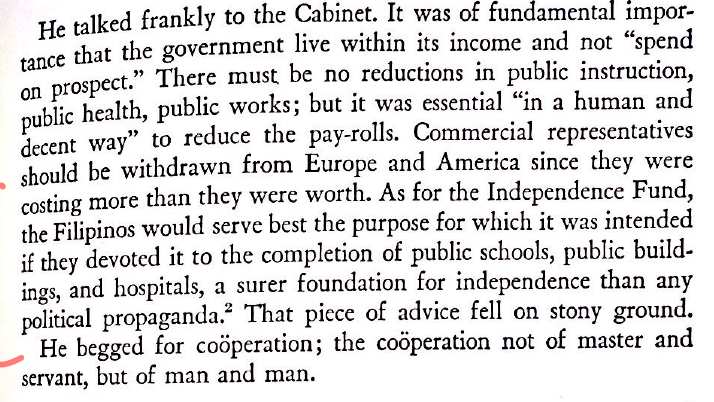
Wood's observations, as seen in the film, were lifted from his biography. That part where a Filipino thought independence was good to eat is from his notes below.

With "Manifest Destiny" in play, the Americans embraced their sense of superiority, and Leonard Wood took his job seriously. This sentiment needed to be depicted in the film with a degree of dispassion so that we could outline the system in place. Adopting a quasi-anthropological approach, we had to present his conclusions about the inefficiency of the Filipino officials without wincing.
Wood, in his administrator mode, wanted to deal with Filipinos squarely, not as "master and servant, but of man and man." Yet his actions in the Bud Dajo massacre decades prior contradict this sentiment.

Is it possible that a career soldier like Wood applied a different set of rules during war time and his later administrative years? In any case, the corruption and mismanagement of Filipino officials were well-documented. So while Wood highlighting the ineptitude of Filipino officials reeks of imperialism and selective outrage, it doesn't automatically invalidate his conclusions.

Were the Americans just as corrupt and opportunistic? Absolutely. Their imperial ambitions came with many tragedies and injustices inflicted on Filipinos. In fact, one of the admirable things about Manuel Quezon was his courage in litigating corrupt and greedy Americans when he was a young lawyer. Young man had balls.

Unfortunately, the film doesn't have the space to go through American criminal behavior in the Philippines, except for the few that intersected with Quezon's life. We rely on discourse from historians to fill in the gaps.
There's a line of reasoning out there that says our past leaders must be held to different moral standards because they lived in different times. That is true to a certain extent, but if there were already legitimate criticisms from their contemporaries about the very same behavior during their lifetime, it's fair to say some moral standards haven't changed.
I suspect there's a cultural component to the path our leaders often take. The anthropological Big Man—provider, father figure, problem solver—is a persistent system that enables corruption, the padrino system and strongman politics. It exists in constant tension with our aspirations for Western-style liberal democracy.
One of the loftier aspirations of the trilogy is to trace the roots of the current system in the hopes that someone out there will know how to change it. Embedded in this hope is the notion that it's possible to sift through bygone people's choices, behavior and identities with the gift of hindsight. As much as possible, we try to resist essentialism. People are many things at different times.

The family vacation scene recalls the scene in HENERAL LUNA where officials used military trains for sightseeing with their families. The difference here is there's no Antonio Luna to whip them to shame.

Some people think we time the release of the Bayaniverse films to a relevant current event, but unless we have a hundred factors aligned, things don't really work that way. When QUEZON came out, the country was fresh from the drama of Senate corruption scandals and the flood control mess. We didn't plan for that. It was impossible.
From an existential standpoint, it's actually worse that the film was so timely. It just goes to show how these ridiculous power games at the expense of the Filipino people have always existed. Maybe the dream is that someday, films like QUEZON will be a relic to a bygone era, not a reminder of how things just never change.
There's only one throwaway line in the film that mentions Leonard Wood's involvement in the Bud Dajo massacre. It's in this scene.

It's definitely important to tell that story, but QUEZON is about Manuel Quezon's power games and not Leonard Wood's crimes. I suggest people see Sari Dalena's CINEMARTYRS if they want a bit more of Bud Dajo.
A number of key historical figures have made comments about Quezon and Osmeña's longstanding feud. Sumulong, Kalaw, Palma, Roxas, Wood, all had something to say about the rivalry. Sharing a few here.
One of my favorite bits of trivia from the feud between Quezon and Osmeña was their competition over refreshments. Quezon knew how to spoil his friends and the media.

As for the Colectivistas vs Unipersonalistas drama, that's a complicated narrative that we had to unfortunately squeeze to near-death in a tango-fueled montage. No need to share pages here. There's plenty of context in online sources.
With the narrative compressed, the whole drama turns into vibes. All that matters is the experience of conflict, of the black-and-white nature of it all. "Sa pula, sa puti" as Doña Aurora would put it.
If it isn't obvious enough, this is not Jericho Rosales's back.

We did a classic Texas switch. We had the double in frame, panned left to Karylle, had the double dive out of the way, panned right back just in time to catch Echo pulling down his shirt. Why? We needed a thinner back to suggest poor health. Echo's toned muscles won't sell it.

Doña Aurora's skepticism about Quezon fighting under the collectivist flag is partly inspired by this.

Also, Adrienne Vergara, the actress who played the demented nurse in my 2016 film BLISS, makes an unrecognizable cameo here. If you have sharp eyes, you'll see the one detail that ties her to Lilibeth/Rose.

Quezon being described as a chameleon isn't something we made up. Check below. Though the word "chameleon" wasn't specifically used, the way the Americans describe Quezon means pretty much the same thing. Some of Wood's dialogue was taken verbatim from the books, though it was Forbes who made these specific observations.

This top shot is foreshadowing for the 4D chess game that Quezon will be playing in the lower house. The moves are from an actual legendary game called The Immortal Game played in 1851. The congressmen will be doing the same moves later.

This is my favorite shot in the film because of how the audience's eyes shift planes as the scene progresses. Every move Karylle made in her chair had to be timed perfectly to block out the camera's reflection on the small mirror on the desk. Echo had to time his movements to make sure Karylle didn't react too early or too late. The small mirror HAD to be there though because it provided a brief "bridge" where the audience can still see Aurora's face as the camera moved to its final position. We did more than 10 takes. I think it was somewhere around 13. Not excessive but still tough.

Quezon as a ladies man is well-established in the books. On the surface, it's easy to understand and accept—handsome Spanish-Chinese mestizo, charming, well-dressed. It figures. Then you dig deep enough and things become messy real quick. In this scene, we could only bring up his engagement to four other women when he was already in a relationship with Aurora. We had to leave out other juicy details for brevity's sake.
The one fun detail we left out that I wish we didn't: Hollywood actress Madeleine Carroll fell in love with MLQ. To think our film is also about movies. It would've been a good fit, but alas, film is a medium of omission.
It's also well-known that Aurora is Quezon's first cousin. Once again, dig deep enough and you'll find reports claiming something else...

What a mess. While this tidbit is definitely worth exploring, it had no place in the story we were trying to tell. As I often mention in Q&A's and interviews: pick any decade in Quezon's life and you'll find a story worth telling.
The game of appointments. I had an internal debate whether or not I really wanted to do this chess set piece. On one hand, expressing Quezon as master manipulator through a chess game is obvious. On the other, I'll never get another chance to pull off something like this ever again. So we did it.

The entire set piece took a full day to shoot. The tables were colored light and dark alternately for the board. Congressmen wore light or dark suits and were positioned according to a specific point in The Immortal Game (near the end). Every congressman moved according to the game's moves. Only Quezon moved freely, doing his thing, controlling the game. It was a fun and tiring day.
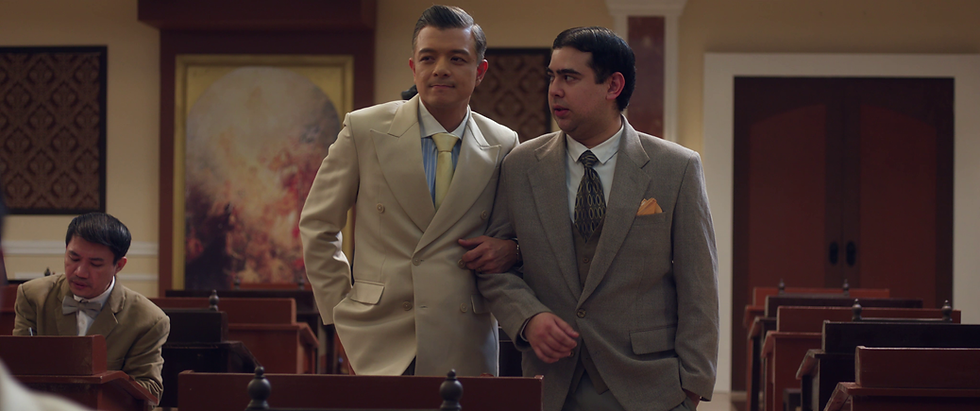
Their entire conversation in the film was lifted from the Quirino book.

Quezon gaming the system to get Manuel Roxas elected as Speaker of the House was also in the book. But the way he nudged Antonio de las Alas out of the race played out differently in real life (or, at least, in the book). Still, it's the same principle of using leverage.

One thing I was sad to leave out was Quezon doing the OPPOSITE at another point in their careers. After exploding in anger at Roxas for some drama regarding the position of Secretary of Finance, he appointed De las Alas to get back at his protege.
As for Manuel Roxas. Quezon had his eye on the young governor of Capiz for a while now. Blessed with the same fiery oratorical gifts as Quezon, Roxas was a rising star.

In no time, Roxas was part of the in-group and held his own with the rest. At some point, he would have a falling out with Quezon and deliver a speech addressing Quezon's two-faced nature (more on this in Part 3). While I would've loved to recreate some iconic historical photos showing Quezon, Roxas and Osmeña in suits, there just wasn't room for more Roxas in the story. It's too bad because JC Santos is one of the best actors working today.
When I was blocking this scene, I told everyone that we're aiming for "cartoons." Snappy movements, brisk pace, choreography. I went as far as I could without having them break out into a song-and-dance number (Osmeña and Quezon did dance at the end of the film).

Tango music, foxtrot, classical music from the Russian romantic era, silent film scores—all these genres propelled the film. The actors' movements, the film's pace, the forward momentum and levity were all inspired by music.
Behold my first experience of Jericho Rosales horsing around. This was early in the shoot and, while I knew Echo was a great improviser, I wasn't prepared for it as we hadn't really spent enough time together yet. There was an awkward silence after I called cut and kept asking what happened. When I reviewed the take, that's when I realized he was just trying to lighten things up. Cartoons, of course. Exactly the right instinct, but I was slow on the uptake.
This scene condenses several threads about the issue of the Philippines' readiness for independence.

Filipino officials had to appease the Filipino public by being pro-Independence even if they knew it would be too complicated to pull off. There were tradeoffs to consider. In some cases, officials believed it would be beneficial to keep the Americans around (for whose gain is debatable). Of course, this idea was outrageous to true nationalists. Much of the conversation in this scene was derived from or inspired by several sources and periods. Sharing a few here.
Also, I loved Romnick's accent in this scene. The way he says "country" sounds so...old. It's amazing.
Once again, the complicated drama is condensed into a simple power play move to get Roxas in position as Speaker of the House while rendering Osmeña "useless" in the Senate.

Quezon's resignations throughout his career could be interpreted several ways, but it's not difficult to view them as power plays.

As mentioned earlier, in certain scenes, the details matter less than the sensation of conflict and the impression of manipulation. This often irks some historians and pundits, with the angrier ones calling our loose approach "dangerous." But I suppose historical films deserve that anger because they trespass over a domain heavily guarded by academia and the intelligentsia. Historical films are traditionally expected to show audiences how things were, but with the trilogy taking a different approach, the tension becomes unavoidable.

Osmeña's pained smile. Romnick does wonders with a quiet supporting character.

Below are Osmeña's thoughts on the power play.
Also, I'm not sure if Romnick Sarmenta managed to read this passage in the Osmeña books, but he sure nailed it.

About the song. I've always loved Connie Francis's rendition of "Who's Sorry Now?" and was overjoyed to learn that the composition is actually in the public domain. I wasted no time including it in the list of public domain songs I recreated for the film. All arranged in Logic Pro, with the vocals provided by the Synthesizer V plug-in. Synth voices reside in the ethical side of AI in that they're not based on content theft, they're powered locally by your computer, and they're not prompt-based. You use them like virtual instruments, inputting notes manually then fine tuning everything using knobs and graphs. It doesn't replace the magic of real singing (although synth voices come from real human singers who provided their voices with consent), but they're good enough in specific use cases.

Just a bit of trivia: Therese Malvar plays Nadia Hernando, goddaughter of Quezon. In real life, Therese's lola is an actual goddaughter of Quezon. Source: Therese herself. :)
To be continued in Part 3.


Comments